


In 1918, his family relocated to Warsaw, where he started his university studies in history. In 1920, together with his brothers, he volunteered to fight against the Bolsheviks in the Polish–Soviet War and lost his right hand in combat. After the war, he returned to the university to attend the medieval seminar led by Marceli Handelsman and was later counted among his most distinguished students. Having received his doctorate in 1924, he spent two years doing post-doctoral research in France, Italy and England; in 1929–1930 he stayed in Paris and Heidelberg thanks to the funding he obtained from the National Culture Fund. His habilitation degree was confirmed in 1931 after his return to Poland. In 1933, he served as secretary to the 7th International Congress of Historical Studies, which was held in Warsaw, and was awarded the Gold Cross of Merit for his accomplishment of that task.
Professor Tadeusz Manteuffel
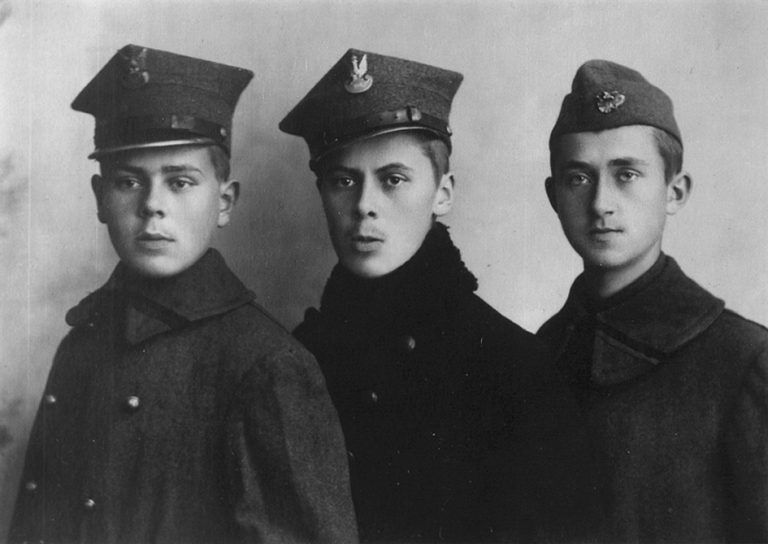
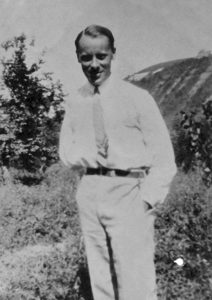
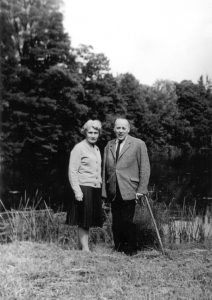
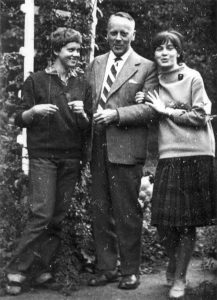

During the Second World War, he was one of the most important members of the Polish intelligentsia involved in civil resistance to the occupying Nazi Germans. From the spring of 1940 to the summer of 1944 he acted as secretary to the editors of Wiadomości Polskie [Polish News], the chief media outlet of the Union of Armed Struggle–the Home Army. In the autumn of 1940, he became involved in organising the history section of the underground University of Warsaw. He led the section and was one of its lecturers. In 1944, there were as many as 12 lecturers and 90 students, some of whom later became professors: Krzysztof Dunin-Wąsowicz, Jerzy Michalski, Zbigniew Wójcik, Andrzej Wyczański and Andrzej Zahorski. Another strand of his underground activity was his cooperation with the Bureau of Information and Propaganda, a department of the Headquarters of the Home Army. For this reason, far-right-wing activists put him on their blacklist of left-leaning individuals. In the wake of ‘Cain’s crimes’ (the murdered included his friends from the Bureau, Ludwik Widerszal and Jerzy Makowiecki; the fugitive Marceli Handelsman was denounced to the Germans), he fled Warsaw in mid-July 1944.
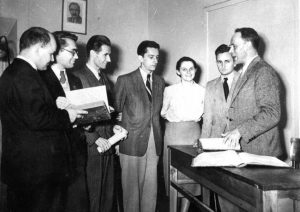
He had returned to Warsaw, on foot, by January 1945 and on 1 February signed up for work to reinstate the university. He dissuaded Aleksander Gieysztor, who asked him for advice, from joining the underground armed resistance, believing that the restoration of universities was more important. Tadeusz Manteuffel held a professorship at the University of Warsaw from 1 September 1945 to 30 September 1968. In 1945–1955, he served as the head of Institute of History PAS; he was also the dean of the Faculty of Humanities and vice-rector of the University. In 1950–1953, he was the chairman of the Polish Historical Society.
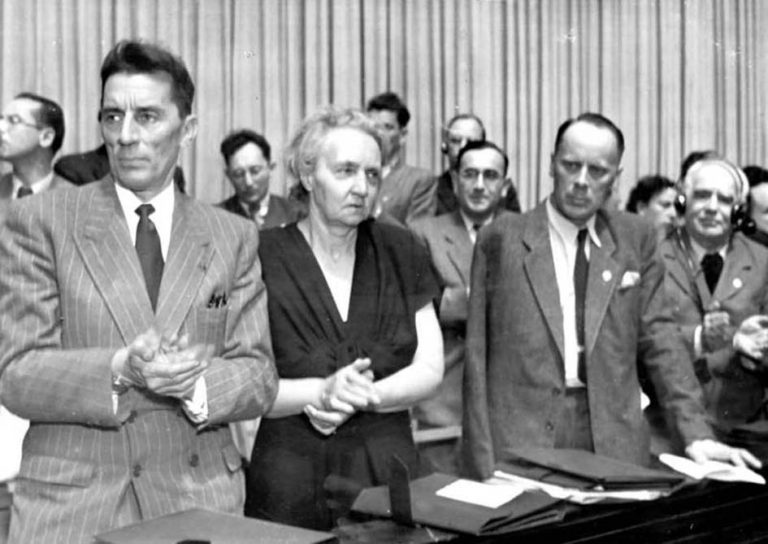
Being a member of the Polish Academy of Learning and of the Warsaw Society of Friends of Learning, he was appointed as a member of the organising committee of the Polish Academy of Sciences by the First Congress of Polish Science on 2 July 1951. Member of the Presidium of PAS from 1958. The act of nomination to the position of director of Institute of History PAS is dated 1 January 1953. It has to be emphasised that this nomination was accorded to a non-partisan scholar, uninvolved in political activity of any sort. Owing to his outstanding organisational talent, he managed to take Institute of History PAS to a position as one of Poland’s leading institutions devoted to research in Polish and universal history. His several-week stay in Paris in 1960 was for him more than enough not only to secure scholarships for Polish historians from the sixth section of the École Pratique des Hautes Études, but also to make contact with Jerzy Giedroyć and Maisons-Laffitte, which made it possible for the Institute’s library to receive copies of the periodicals Kultura and Zeszyty Historyczne.
Manteuffel’s lecture at the eighth Congress of Polish Historians, which took place in 1958 in Krakow, proved to be of great significance for post-war Polish historiography on account of his harsh criticism of the Stalinist system that aimed to subjugate the study of history to serve the political agenda. No less important was his condemnation of the anti-Semitic campaign unleashed by the state in March 1968.
The moral authority of Tadeusz Manteuffel that resulted from his many accomplishments and from his role as ‘opinion leader’ of Polish historians bore fruit years after his death, with a number of his students, notable historians in their own right, making a significant contribution to the formation of the Third Republic of Poland, including such eminent scholars as Bronisław Geremek, Jerzy Jedlicki, Krystyna Kerstenowa, Karol Modzelewski and Henryk Samsonowicz.
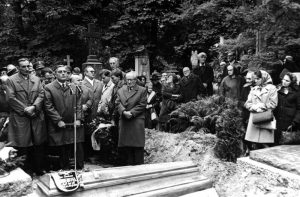
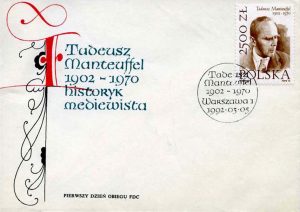
Tadeusz Manteuffel led Institute of History PAS until his passing. He died in Warsaw on 22 September 1970 and was buried in the Avenue of Notables of the Warsaw Powązki Cemetery. Author of the university handbook Historia powszechna. Średniowiecze [A Universal History. The Middle Ages], which was printed in several editions, his best known work was Narodziny herezji. Wyznawcy dobrowolnego ubóstwa w średniowieczu [The Birth of a Heresy: Voluntary Poverty and its Professed Adherents in the Middle Ages] (three editions in Poland, two in Italian, as well as translations into French and German). In 1976, the commemorative book Historyk wobec historii. Rozprawy nieznane, pisma drobne, wspomnienia [A Historian and History. Unknown publications, contributions and memoirs] was published (edited by Manteuffel’s student, Stanisław Trawkowski). In 1982, a street in the Warsaw district of Gocław was named after him. Institute of History PAS has borne the name of Tadeusz Manteuffel since 1994, and a plaque was unveiled in 2012 on the façade of the Institute’s seat in Warsaw Old Town Square to commemorate its originator.
Text and selection of photographs by
prof. dr hab. Tomasz Szarota

