The seat of the Institute consists of two connected brick houses situated in a block of plots by the Old Town Market Square (the Kołłątaj’s side): houses nos. 29 (cadastral no. 47) and 31 (cadastral no. 48). The latter brick house occupies a corner plot and reaches along Wąski Dunaj Street to Piwna Street, where the former outbuilding is marked with a separate number (Piwna 48).

House No. 29 was built before 1442 (at the time it belonged to Andrzej Grabski) and was the first brick house in this sector of buildings by the square. In 1444, it became the property of Andrzej Kazub, a merchant from the petty nobility of Korytów in the Wyszogród land. The progenitor of a distinguished family in the patriciate of Old Warsaw, he maintained business contacts with Gdańsk, Poznań, Wrocław and Kraków, and visited Rome. In 1478, he bought the princely village of Duchnów in the Warsaw land. He was a juror and then a councillor, and in the years 1480 (?) and 1493–1494 mayor of the city. After 1502, when Andrzej Kazub and his son Jan died, the house belonged to the widow of Jan, Małgorzata, and their children. Numerous remains of Gothic architectural motifs and a brick portal have been preserved in the cellars and ground floor walls from before the mid-16th century.

Around the middle of the 16th century, the brick house passed into the hands of another patrician family – the Gizas. The owners of this particular house attested to in the sources are: Jakubowa Gizina (1612), Mikołaj Giza son of Jakub (1640), Gizina widow of Mikołaj (1656, 1669). In the 18th century, the house was called Sakresowska, as it is known that in 1741 it was owned by Michał Sacres, a juror and later the mayor. Around the middle of the 18th century the house was rebuilt, among other things receiving a new façade. In 1754, it belonged to Ignacy Nowicki, the Crown Metrican, and in 1788–1846 to Józef and Anna Filipecki and their heirs. After being destroyed in 1944, fragments of the ground floor walls with the portal have survived. In the years 1951–1953 the brick house was rebuilt to the design of Wacław Podlewski, with the reconstruction of the body and façade from the mid-18th century.

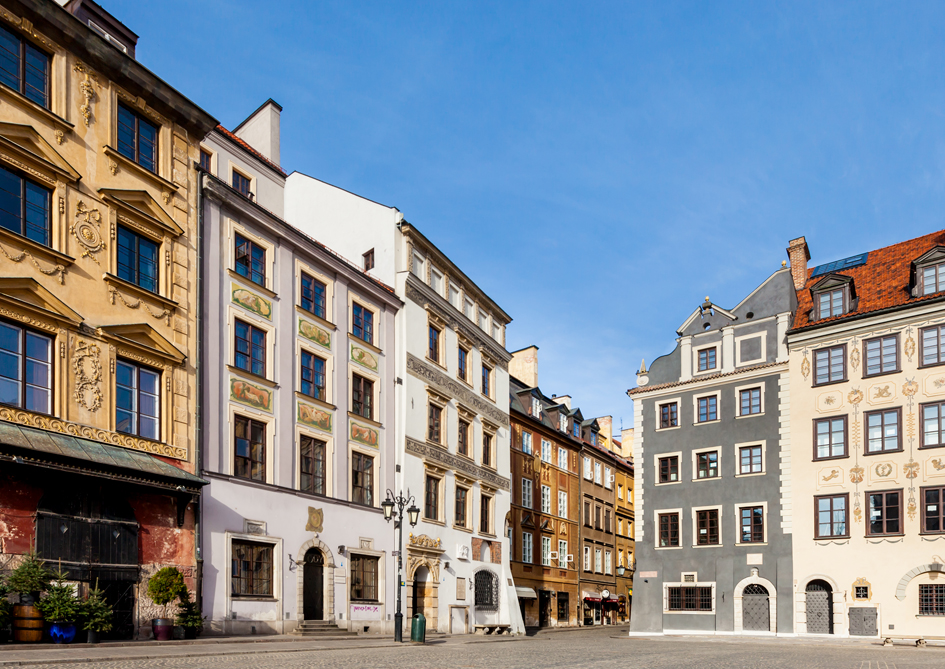
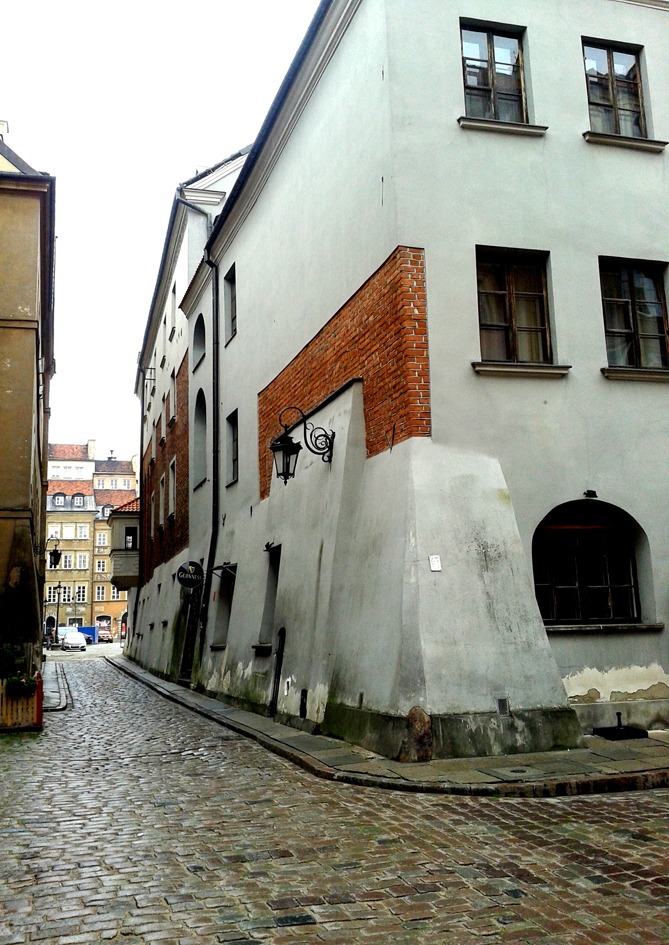
The seat of Institute of History PAS seen from the corner of the Old Town Square and Wąski Dunaj Street

House No. 31 is currently called “Under St Anne”, and by historians of architecture it is referred to as “Plumhoff’s brick house”. From the first half of the 19th century it was erroneously described as the “house of the Dukes of Mazovia”.

In 1440, the wooden house of the brothers Rafał Suchopędek and Wawrzyniec the furrier stood there. The front part of the building was built before 1466. From that time fragments of cellar walls and the Gothic wall by Wąski Dunaj with five tall, narrow ogive niches have survived. Next, further construction was carried out, reaching the courtyard (to the location of the later staircase). In 1468, the owner of the house was Małgorzata of Małodobry, the widow of Maciej Rzepka; she had two sons, Kasper and Jan, and three daughters (Helena became wife of Mikołaj Skarga of Grójec).

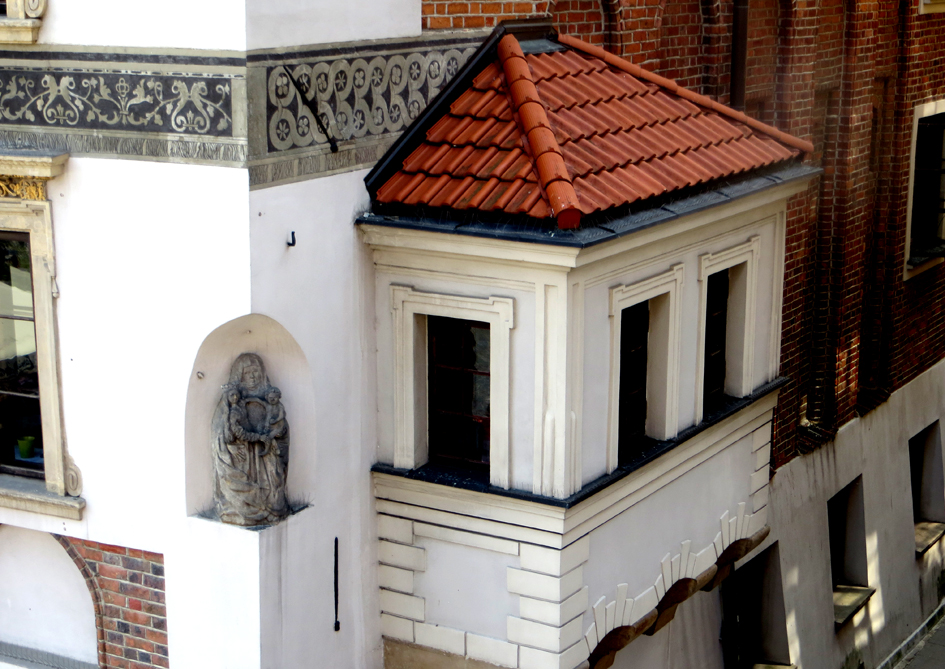
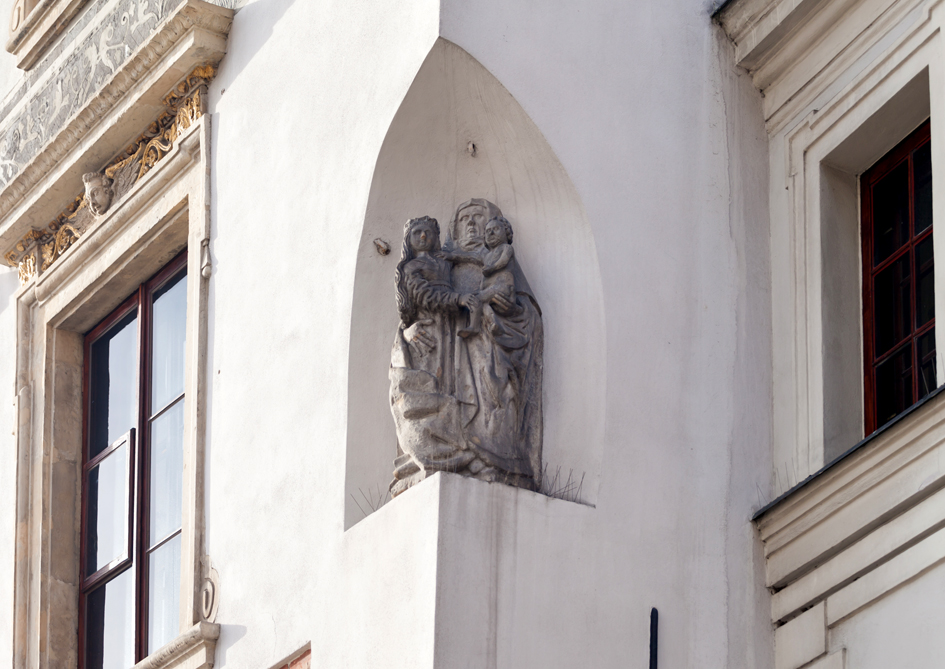
The owner of the neighbouring house (i.e. no. 29), Andrzej Kazub, bought house no. 31 probably shortly after 1468. In 1502, his son Mikołaj was given half of the brick house, and the other half was given to Małgorzata, the widow of his son Jan, together with their children. As early as in 1506, Mikołaj Kazub owned the entire property. This outstanding representative of the Warsaw patriciate, a merchant with extensive commercial contacts, was repeatedly elected to various positions in the city authorities: from 1505 he was a juror, from 1511 a councillor, and from 1520 to 1523 and in 1526 served as mayor. Taking advantage of his rights as a nobleman, he owned land and had connections with the court of Duke Conrad III the Red. He died before 8 March 1527. His son was Stanisław Kazub. In the first third of the 16th century, the Kazubs reconstructed the house (the date of 1535, once located above the entrance, may have marked the end of work). The building was then given a new façade with ogive window niches on the ground floor (partially preserved). In a shallow recess above the corner buttress there is a late Gothic statue of St Anne with the Virgin and Child. This sculpture is probably connected with the wife of Andrzej Kazub, Anna, who died before 1513. The cellars on three levels have been preserved, covered with mostly barrel vaults, but also ogive vaults, including traces of stairs to the Market Square and windows to Wąski Dunaj Street. Two portals from that time were moved to the hallway in the 17th century – one with jambs and a lintel covered with intersecting bars is original, the other with Christ’s head was rediscovered in 1953. At the same time as the works in the main part progressed, a brick outbuilding was built in place of wooden sheds, together with a deep structure adjacent to the yard that was probably a well.

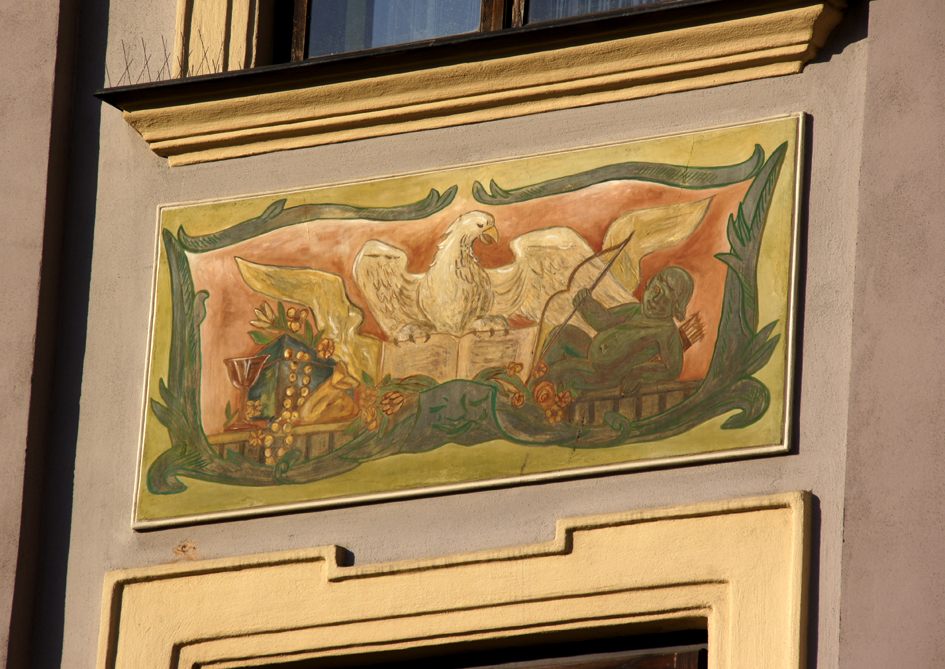
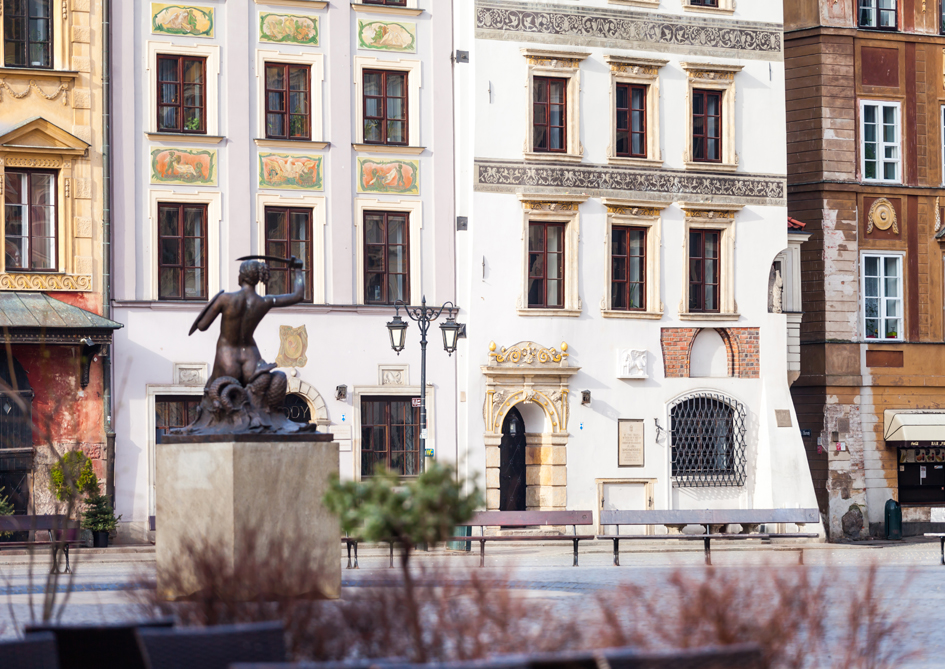
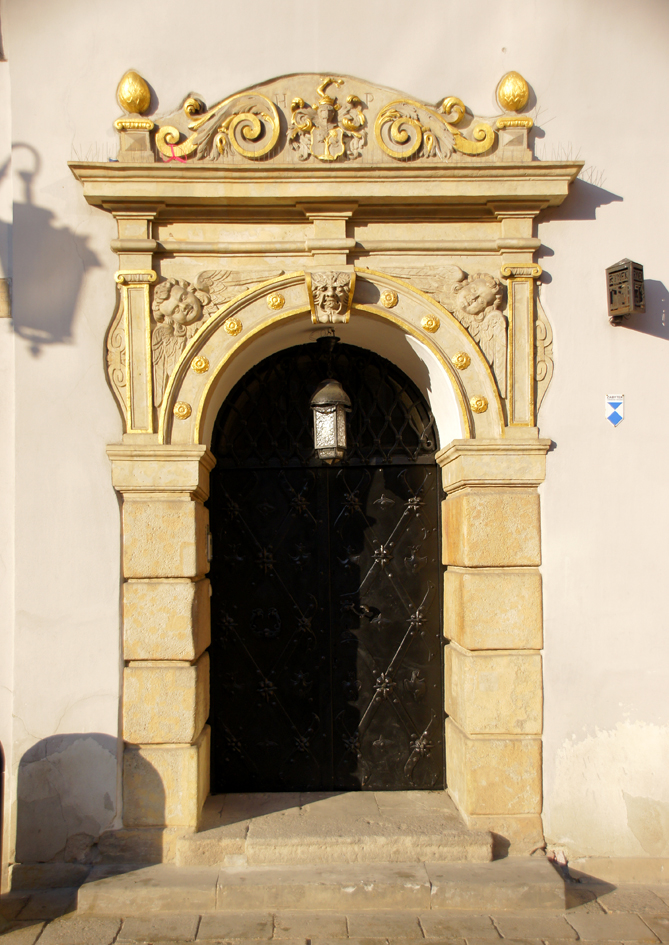
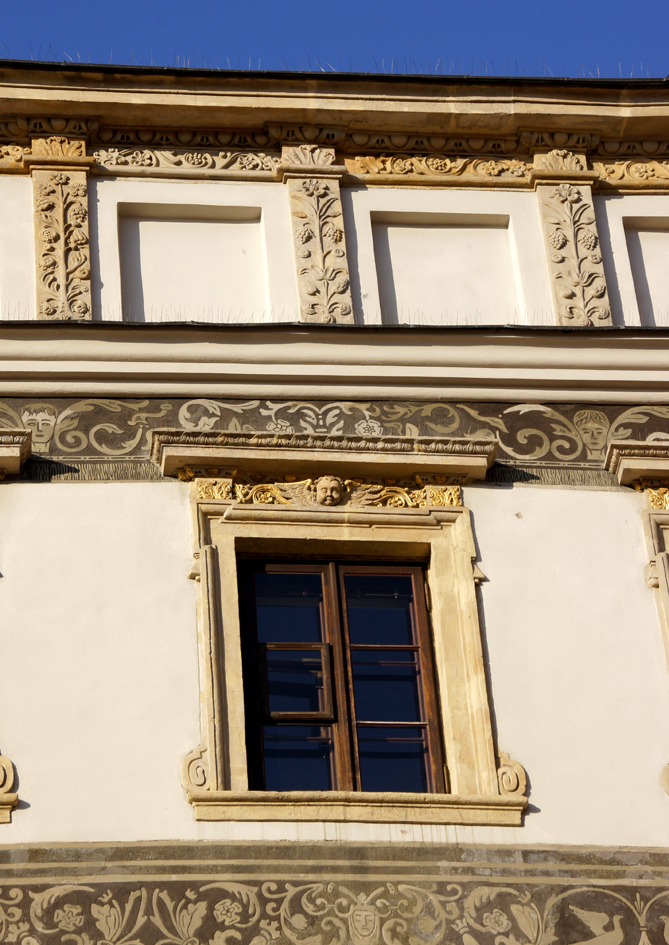
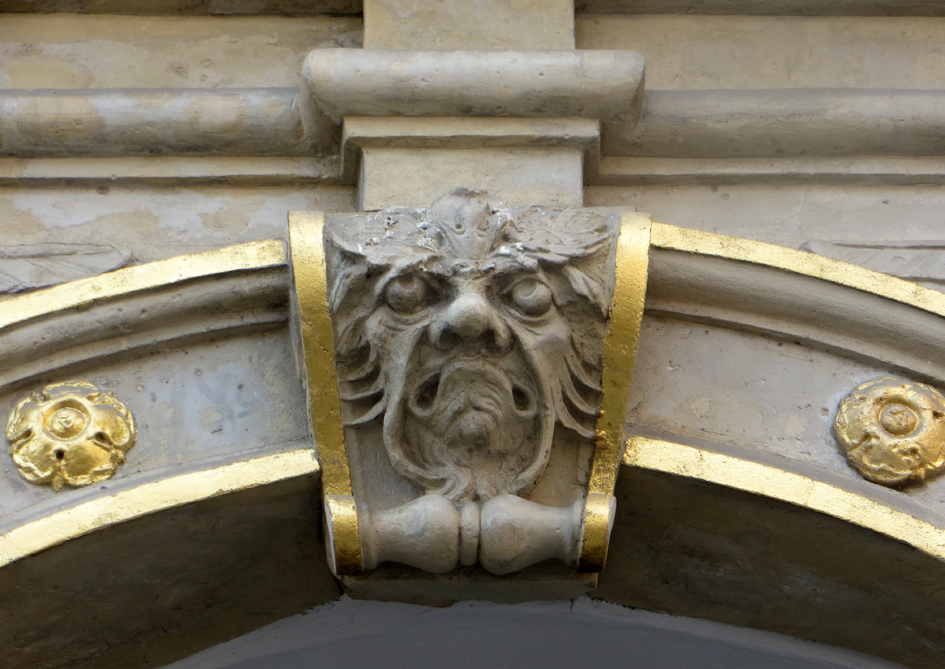
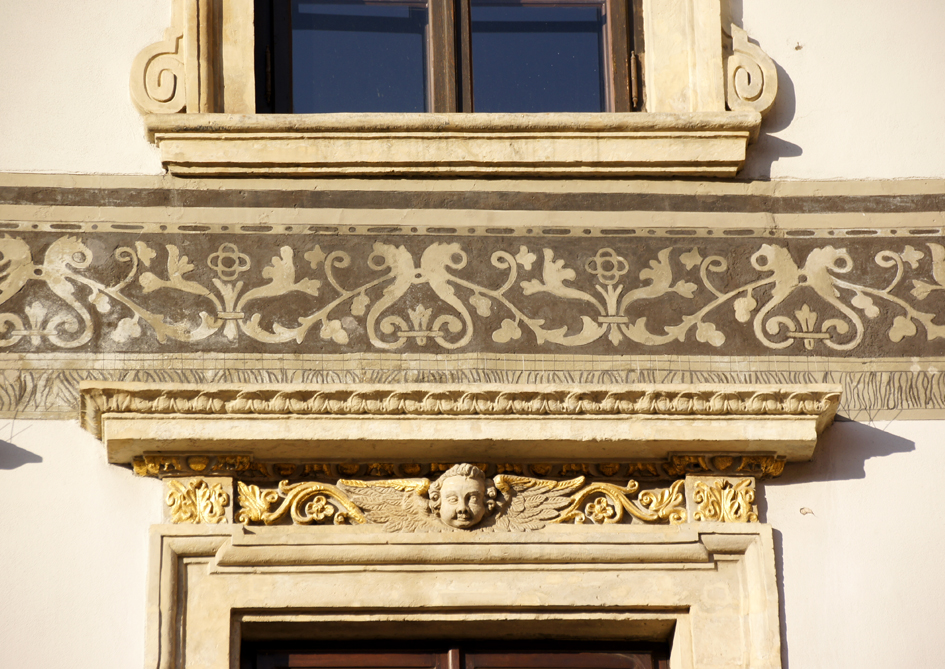
In 1556, a goldsmith from Cracow, Adam Szałapski, purchased the house from the Warsaw judicial clerk Stanisław Jeżewski. It was inherited by Szałapski’s descendants, mostly owning half of the property. Henryk Plumhoff, a merchant from Gdańsk, many a time a juror, councillor and mayor of Old Warsaw, bought one half of it in 1630 and the other half in 1635. At that time the brick house was thoroughly rebuilt. The interior layout was changed. A new façade was created with a late Renaissance portal, which is crowned with a cartouche with a house mark in the form of a noble coat of arms and the initials “H. P.”. New window frames were given, while the upper floors were marked with sgraffito friezes continuing on the side façade. A bay window was added to it on the first floor at the eastern corner. The front wall is topped with an attic. Henryk Plumhoff died in 1637.

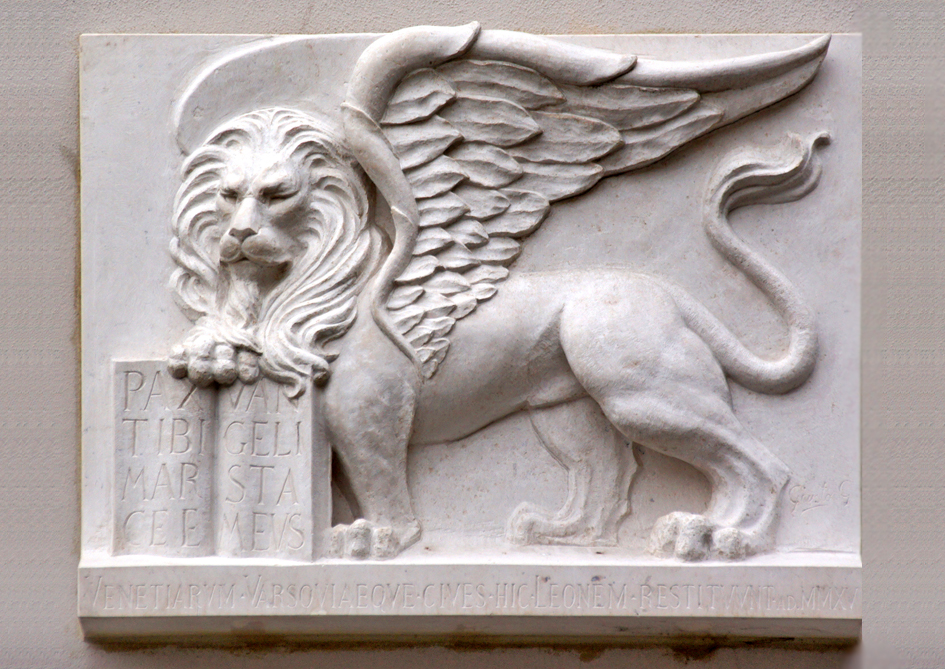
Between 1671 and 1674 the brick house was bought by Dawid Zappio, a Venetian merchant who maintained relations with the city. He was a member of the Old Warsaw bench and council, and mayor in the years 1683–1685 (he died before 1699). On the façade, he placed a bas-relief depicting St Mark and the lion, the patron saint of Venice and its symbol (the bas-relief was destroyed in the second quarter of the 19th century). From 1699 to 1732 (?) the house belonged to the Winkler family, and later to the Drewniks. In 1741–1757 the owner was Jan Chryzostom Kostrzewski, a doctor of medicine with a diploma from Montpellier. He carried out a renovation of the outbuilding, which changed the façade from the side of Piwna Street, and built a new portal with his initials and house mark and the date 1746. Kostrzewski’s heirs sold the entire building in 1766 to Wojciech Lobert, who rented the interior to the French restaurant Quellus. The property belonged to the Loberts until 1806. In 1834 it was purchased by Franciszek and Marianna Tietz, who reconstructed the brick house: they changed the interior divisions, connected the main part with the outbuilding with a common staircase and curtain wall from Wąski Dunaj, and removed some elements of the façade.

In 1913, thanks to the financial donation of Adam and Ludwika Czartoryski, the house was bought by the History Appreciation Society from private owners. Research and conservation work was carried out by Władysław Marconi and Jarosław Wojciechowski, including the uncovering of Gothic elements. In the front part, a large hall was built on the first floor and, above it, two floors with smaller rooms.

The cellars, vaults on the ground floor, most of the façade and the side elevation survived the damage of the year 1944. The brick house was rebuilt in 1948–1953 to the design of Jan Grudziński, preserving the surviving elements, with newly designed interiors, which on the ground floor refer to the state from before 1944. During the reconstruction of houses no. 29 and no. 31, their interiors were connected. Both houses were designated as the seat of the Institute of History of the Polish Academy of Sciences, but they are also the seats of the Polish Historical Society and the History Appreciation Society.

Henryk Rutkowski