


‘Worlds of the Slavs’. The power of emperors, elites, and the veche. Who needs it?
The Tadeusz Manteuffel Institute of History of the Polish Academy of Sciences
The Polish Young Academy of the Polish Academy of Sciences
Committee of Slavic Studies of the Polish Academy of Sciences
Museum of the Origins of the Polish State in Gniezno
Faculty of Archaeology of the Warsaw University
Academy in Piotrków Trybunalski
Lithuanian Institute of History
We cordially invite you to the fourth in a series of conferences on the theme
‘Worlds of the Slavs’
The power of emperors, elites, and the veche. Who needs it?
Gniezno
September 16-18, 2026
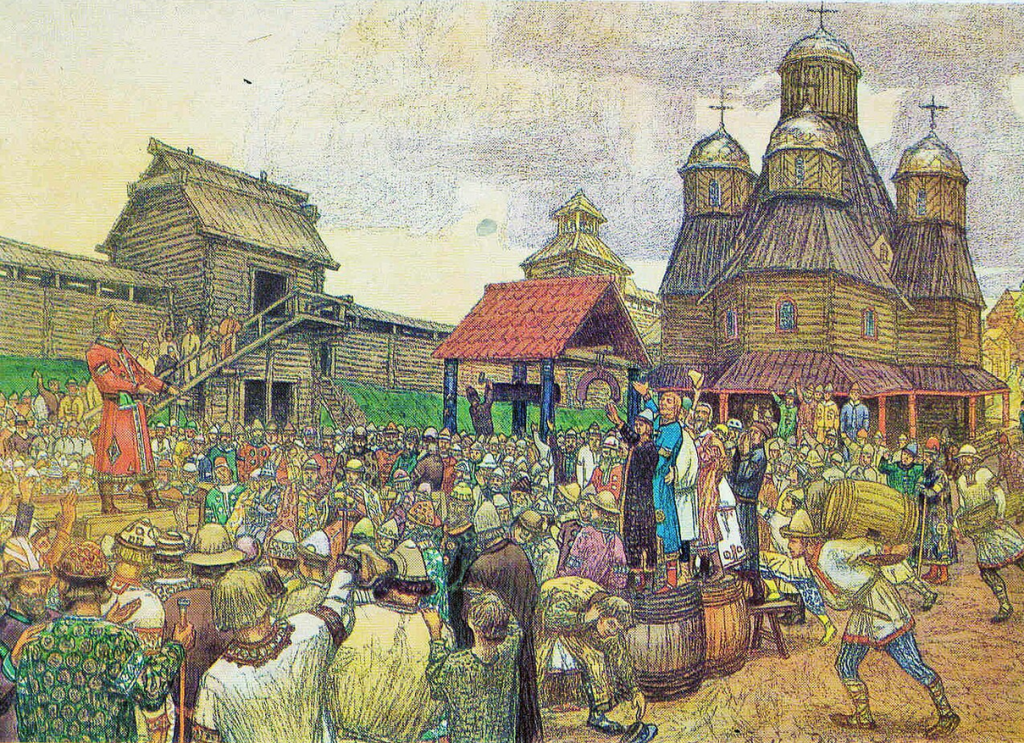
Pskov Veche by Apollinary Vasnetsov (1908–1909) – source https://en.wikipedia.org/wiki/Veche#/media/File:Pskov_Veche_Vasnetsov.jpg

On the behalf of the Organizing Committee we would like to invite to participation in the fourth hybrid (traditional and on-line way) Conference “Worlds of the Slavs”.
Our somewhat provocative title concerns the origins of power in the Slavic world, focusing on the political organisms which emerged there from the perspective of both ruling elites and their subject groupings – whether tribes, peoples, principalities, or kingdoms. To what extent did medieval political organisms emerge through conciliation and compromise, or were they more a result of brutal violence, mitigated over time by more sophisticated tools of persuasion such as an ideology based on monotheistic religion? Such questions of compromise with and resistance to centralised power also encourage a focus on those communities in the Slavic world and its borderlands which did not produce strong, centralised monarchies. Previously seen as backward ‘defenders of traditional values’, should we not now see them as defenders of other values – of diffuse, majority-controlled power? The interests of the majority were not always served by a strong, centralised power, especially if this had been imposed through force. And far from being guardians of internal order and defenders against external threats, early Slavic rulers often seem more like criminal cartel leaders, plundering at home and abroad, with their ‘states’ – at least in the early stages – more akin to family-controlled corporations. Are later visions of them as benign rulers in the literary tradition, seeking the spiritual salvation and material well-being of their subjects, largely propaganda? Our conference essentially addresses the question raised in its title: how did medieval Slavic political communities emerge, expand and sustain themselves, and what was the role of elites, rulers and dynasties in this process. We welcome papers which deal with such issues as:
- The part that dynastic legend played in the consolidation of power (the birth of a dynasty or lineage);
- The places that ‘gave birth to power’ (sedes regni, cult sites, mints, communications, and customs chambers);
- Social engineering in the service of the ruler (for example, ruler-inspired settlements);
- The phenomenon of the monarchical court (how did it function; what was its place in the system of power; was it a ‘meritocratic’ resource?);
- The role of writing in creating an ideal of the ruler;
- Princeps fundator (the role of the monarch as founder of churches, commissioner of codices, paintings, and the like);
- ‘Democratia’ – segmented structures and alternative forms of government to the monarchy;
- Religion as an element in social and political order;
- Law as the basis of social and political order;
- Symbolism and rituals of power (including places of coronation, punishment, speech, etc.);
- How to raise a ruler;
- The diffusion of patterns of governance;
- Foreign policy – dynastic policy.
Conference applications should be submitted by 30 March 2026: https://docs.google.com/forms/
The conference languages will be English and Polish. The organizers will provide accommodation.
Should you have any further questions please do not hesitate to contact us at: theworldoftheslavs@gmail.com.
Organizing Committee: Dariusz Adamczyk (Hanover, Germany), Darius Baronas (coordinator, Vilnius, Lithuania) Marta Font (coordinator, Pécs, Hungary), Antoni Grabowski (coordinator, Warsaw, Poland), Adrian Jusupović (main coordinator, Warsaw, Poland), Maciej Lubik (coordinator, Zielona Góra, Poland), Tomasz Nowakiewicz (coordinator, Warsaw, Poland), Aleksander Paroń (coordinator, Wrocław, Poland), Jonathan Shepard (coordinator, Oxford/Cambridge, United Kingdom), Monika Stelmasiak-Majorek (coordinator, Gniezno, Poland), Stepan Stepanenko (coordinator, Schleswig, Germany), Monika Stobiecka (coordinator, Warsaw, Poland), Alexandra Vukovich (coordinator, London, United Kingdom), Constantin Zuckerman (coordinator, Paris, France).

