


The World of the Slavs: Forgotten Meeting Place of Different Cultures
Institute of History Polish Academy of Sciences
Centre for Historical Studies
Institute of Central Europe
The Polish Young Academy of the Polish Academy of Sciences
Oxford Centre for Byzantine Research
Early Slavonic Research Seminar
Centre for East European Studies University of Warsaw
We cordially invite you to the first in a series of conferences on the theme
‘The World of the Slavs: Forgotten Meeting Place of Different Cultures’
in memory of Professor Andrzej Poppe (12 July 1928–31 January 2019)
Christian Russia in the Making
Warsaw (30 January–1 February 2020)
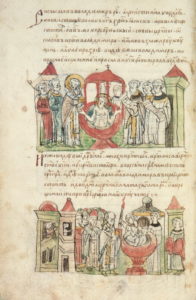
It is no coincidence that we open this series of conferences with ‘Christian Russia in the Making’, since this was the title of one of Andrzej Poppe’s most acclaimed publications in the west. Although probably best-known for his outstanding work on the early Russian church, Poppe’s research had deep roots in general questions of source studies ranging from the ninth to the seventeenth centuries, focusing on Central and Eastern Europe. He spoke about himself thus: “As I set out to acquire the principles of the skills and tools of the craft of medieval studies, I looked for models in the works of scholars who could, regardless of their national affiliation, generally be considered heirs of the school of Leopold Ranke. My particular research interests quickly became focused on the history of the East Slavs, supplemented, of course, by the often wide-ranging problems of Byzantine and West European history that study of East Slavic questions entails. In pursuit of those interests, I have not hesitated to combine a well-developed caution in formulating hypotheses with an openness to working concepts, while always seeking to avoid, however, the kind of unchecked speculation that can lead to […] utterly fantastic conceptualizations […]. Overall, I have preferred a model much like that of combinatorial mathematics, with its method for confronting a set of known facts with various carefully weighed, verifiable hypotheses. While not ruling out a role for intuition, I have allowed it to serve as the raw material for my thinking, appreciating how far off the road it can sometimes lead us. After half a century of research subjected to the hard rigours of the medievalist’s craft, I believe I have succeeded in filling in several small and a few medium-sized gaps in our knowledge of medieval Rus’.” [Andrzej Poppe, ‘Introduction’, Christian Russia in the Making (Aldershot, 2007), pp. vii–viii].
We invite participation from researchers interested in the following topics, which bear on the issues and methodology of Andrzej Poppe’s works:
- History of the church in Rus’
- Culture and politics of Rus and relations with other parts of the Christian world
- Source studies of Cyrillic texts
- Archaeology and material culture in the history of Rus
- Auxiliary disciplines of history in the broadest sense (paleography, epigraphy, architectural history, iconography, sphragistics, numismatics, historical geography, etc.)
- Settlement studies (the nature and formation of towns and patterns of settlement in Central and Eastern Europe)
- History of Slavic studies
Conference applications with abstracts should be submitted by 30 November 2019 to the following address: theworldoftheslavs@gmail.com. The conference languages will be Polish, Russian and English. The organizers will provide accommodation.
Organizing Committee: Dariusz Dąbrowski (coordinator, Warsaw, Poland), Marta Font (coordinator, Pésc, Ungary), Aleksiej Gippius (coordinator, Moscow, Russia), Martin Homza (coordinator, Bratislava, Slovakia), Mirela Ivanova (coordinator, Oxford, United Kingdom), Adrian Jusupović (main coordinator, Warsaw, Poland), Witalij Michałowski (coordinator, Kiev, Ukraine), Aleksander Paroń (coordinator, Wroclaw, Poland), Aleksiej Shchavelev (coordinator, Moscow, Russia), Jonathan Shepard (coordinator, Oxford/Cambridge, United Kingdom), Martin Wihoda (coordinator, Brno, Czech Republic), Aleksandra Vukovich (coordinator, Oxford, United Kingdom).

